
The Webinar Revenue Engine
Also: What is the Worst GTM Strategy in Practice?

In this edition:
The Webinar Revenue Engine
POLL: Which GTM concept sounds good in theory but breaks down in practice?
What the Martech Industry Gets Wrong About Career Development
For Paid Subscribers: How to Influence a CMO (Without Authority)
The Webinar Revenue Engine
Most webinar programs are built like a calendar item.
Register → Attend → Follow-up email → Done.
That’s not a revenue engine. That’s a one-night stand with your pipeline.
The problem isn’t attendance. The problem is architecture.
A webinar shouldn’t be a marketing event.
It should be a go-to-market operating mechanism.
The shift: stop measuring success as registrations or attendees. Start measuring it as how many revenue motions the webinar activates across the business.
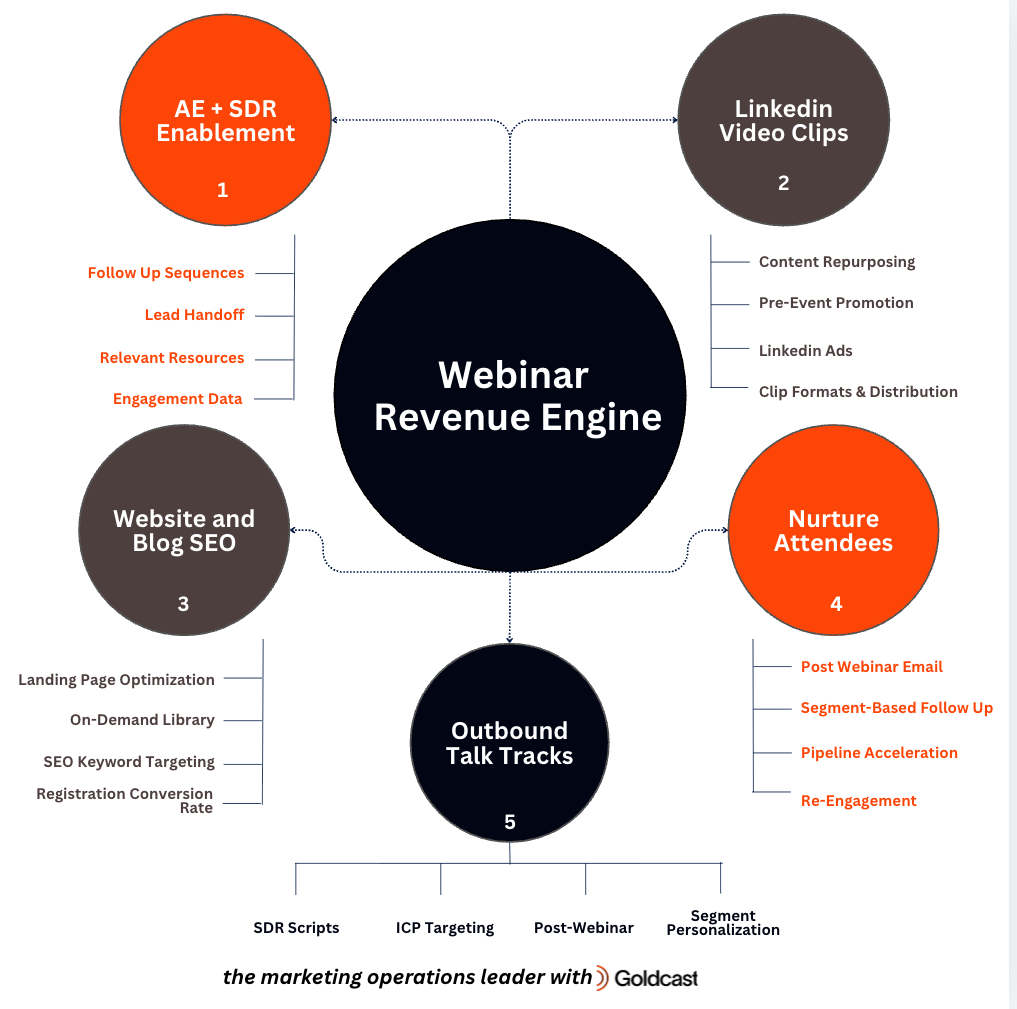
Here’s what that system looks like:
The five components — and where most teams drop the ball:
1. AE + SDR Enablement
Most webinar programs fail before the event starts — because sales isn’t ready.
Your team needs talk tracks, follow-up sequences, lead handoff criteria, and context on what the audience just heard. If they’re learning about the webinar from a Salesforce alert, you’ve already lost the pipeline opportunity.
2. LinkedIn Video Clips
The webinar isn’t the content. The webinar is the content source.
Four to six short clips should warm your audience before the event, extend reach after, feed paid ads, and give sales something shareable. One 60-minute session should generate four to six weeks of market presence.
3. Website + Blog SEO
Your on-demand library shouldn’t be an archive. It should be a pipeline asset.
Webinar pages need to rank for problem-based keywords, drive organic registrations, and capture high-intent buyers mid-research. Your future customers often meet you through Google — not your registration form.
4. Nurture by Behavior
The “thanks for attending” email is one of the biggest missed opportunities in B2B marketing.
Attended live, watched recording, registered but no-showed, engaged with a specific topic — those are different buying signals. They deserve different journeys. Segment accordingly.
5. Outbound Talk Tracks
This is the most underrated piece.
Your webinar gives you new conversation material. Outbound sequences should reference questions asked, objections surfaced, and real examples presented. Now outreach isn’t cold — it’s a continuation.
The engine only works when the pieces connect.
Most programs stop at email follow-up. High-performing teams connect the webinar to sales motion, organic demand, and outbound — all at once.
I’m a big proponent of platforms like Goldcast for exactly this reason. The engagement data, integrations, and repurposing capabilities are what close the loop between webinar content and revenue motion.
If you’re still running webinars as one-off events, you’re leaving pipeline on the table.
AI-Powered Campaign Creation: Ship 5–10X Faster with AI
Knak builds complete, on-brand emails and landing pages — ready to send, without waiting on designers or developers. It integrates directly with Marketo, Eloqua, HubSpot, and SFMC so marketers can launch in minutes instead of weeks.
If campaign creation is your bottleneck (not activation), this is worth a look.
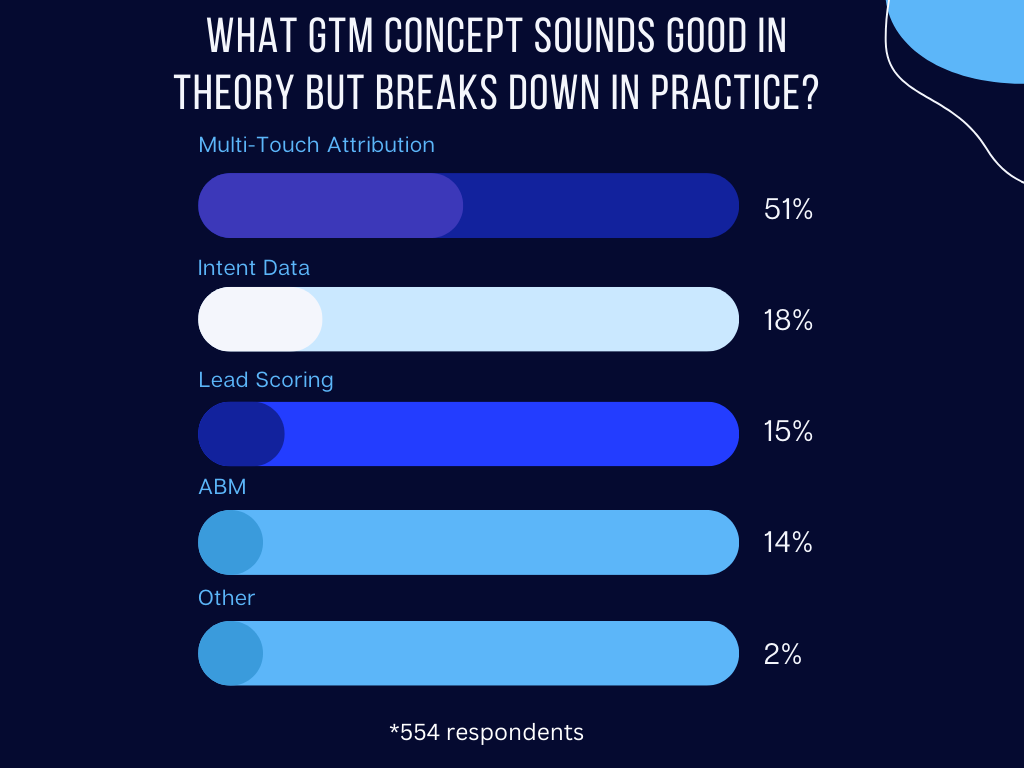
POLL: Which GTM concept sounds good in theory but breaks down in practice?
Top Commentary on Social
Voted for MTA because it has been painful, slow and never right from the start to create a meaningful view of MTA or Markov chain models into a dashboard that allows you to make a strategic or tactical decision without questioning the data or the output many, many times.
The Other one that comes immediately to mind is Opportunity scoring, much worse than Lead scoring. Oppty scoring has been either random or inaccurate. There are also some limitations in the major CRM platforms around standard vs custom objects usage in the modelling, which leads you with the customer engineering path and the pains of MTA. - Evelina Petrova-op den Kelder
MTA is a big one, but none of them are representative of reality. Lead scoring is fraught with bias, as is MTA. Intent data almost always is a lagging indicator, and ABM never took defensive AI into account. It was the best of the options for a decade or more, but it’s falling victim to customer AI filters. - Mark Stouse
What the Martech Industry Gets Wrong About Career Development
We recently sat down with Scott Brinker on Humans of Martech — and walked away with a handful of lessons that reframed how I think about building a career in this industry.
Here’s what stuck.
Tools are temporary. Judgment is permanent.
Most marketers build their careers around platforms. They become the “Marketo person” or the “Salesforce admin.”
And then the tool changes. Gets acquired. Gets replaced.
The career strategy most people are running is fragile — and they won’t realize it until it’s too late.
The AI problem nobody is talking about
Everyone is worried about whether AI will take their job.
That’s the wrong question.
The better question: can you tell when AI is wrong?
AI generates polished, fluent, well-structured answers — and mixes real insight with complete fabrication. The terminology sounds right. The output looks clean. The errors are invisible unless you know the domain.
This is what makes deep specialization a survival skill right now. One true specialty gives you the judgment to use AI without being fooled by it.
Breadth without depth means you can’t audit the machine. And if you can’t audit the machine, you’re not adding value — you’re just adding speed.
You don’t need to code. You need to understand foundations.
SQL, APIs, data structures, how tools communicate — you don’t need to master these from scratch. AI can help you execute.
But you need to understand them well enough to ask the right questions, spot bad outputs, and know when something is structurally broken.
The difference between an operator who understands data foundations versus one who doesn’t isn’t just efficiency. It’s agency.
AI is largely a commodity. What creates differentiation is the quality of the data underneath it — and the judgment of the person directing the work.
The linking muscle most people skip
Everyone knows T-shaped: deep in one area, broad across others.
What gets missed is the third part — the ability to translate between disciplines.
Marketing and engineering. Operations and finance. GTM and product.
Organizations are full of teams that don’t understand each other. That gap is leverage. If you can sit between two rooms and make both sides feel understood, you will never struggle to create impact.
The skill nobody builds intentionally: change leadership
Smart operators build great systems. Run solid implementations. And then nothing gets adopted.
Not because the system was wrong. Because the people weren’t brought along.
Adoption follows trust and clarity — not technical quality. Your job during any implementation is to identify who actually steers decisions, explain the change in language each team can absorb, and stay close to the friction points.
The smartest operators learn this late. The best ones build it early.
How to build a vendor BS detector
If you can’t explain what a tool does in two sentences after ten minutes on their site, something has gone wrong.
Real differentiation in martech comes from four places: technical fit, functional capabilities, economic value, and cultural alignment. Most vendor sites lead with none of these.
Clarity in how a vendor communicates is itself a signal. Companies that explain their value clearly usually run cleanly internally too.
The gap that creates the most opportunity
Technology moves fast. Organizations move slow.
The operators who win understand both sides of that gap — what’s technically possible, and how to move an organization toward it at a pace it can actually absorb.
That’s not a technical skill. It’s not a soft skill.
It’s the whole job.
Listen to the full episode at humansofmartech.com
