
Step-by-Step Create a Martech Strategy for Your Company
Also -How Ready is Your Team for AI Campaign Creation?

In this edition:
Step-by-Step Create a Martech Strategy for Your Company
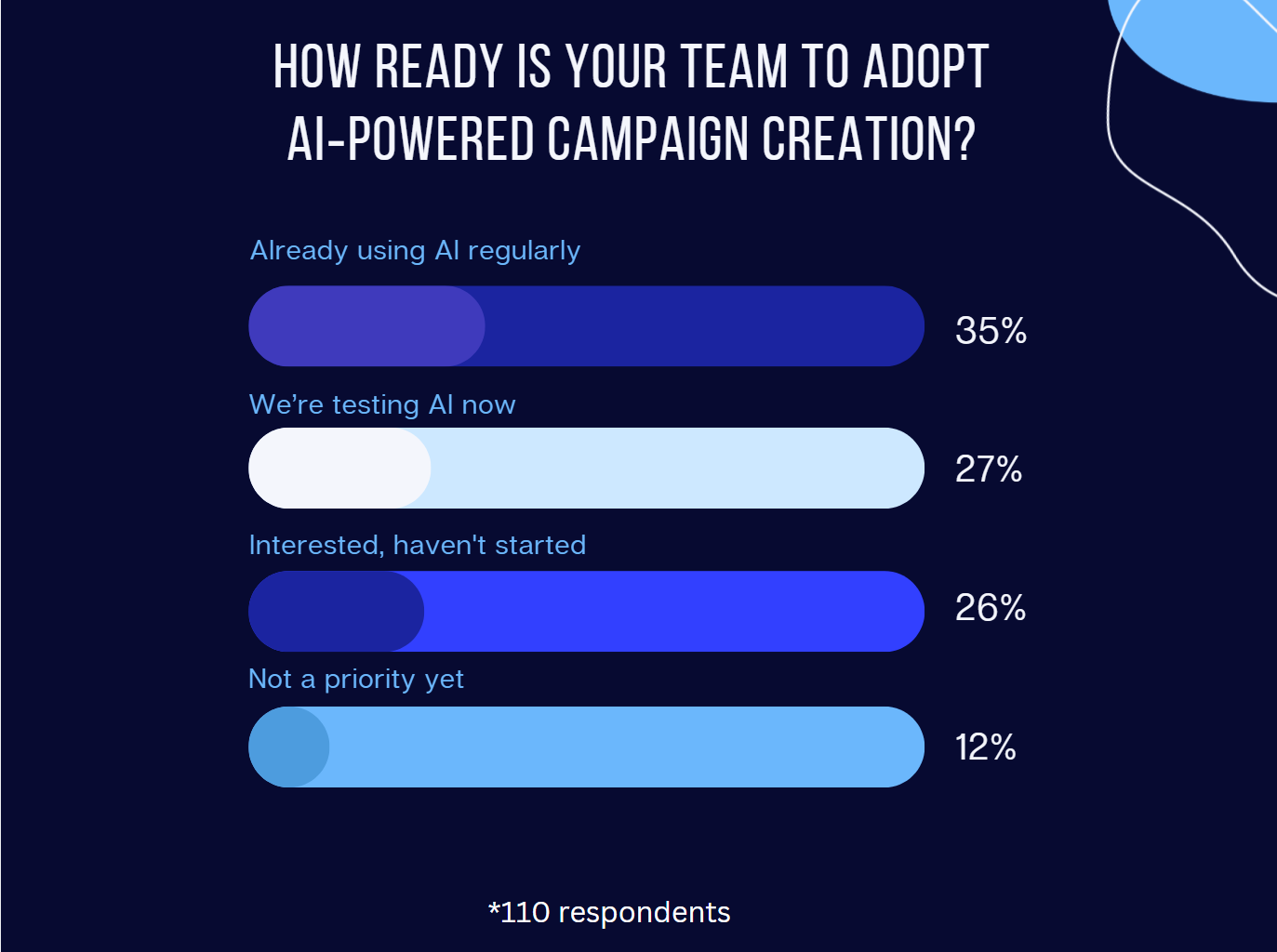
POLL: How Ready is Your Team for AI Campaign Creation?
Exclusive For Paid Subscribers: How Marketing Ops Needs to Handle Executive Meetings and One on Ones
AI-Powered Campaign Creation: Ship 5–10X faster with AI. Knak builds complete, on-brand emails and pages ready to send. Check out Knak AI here.
Step-by-Step Create a Martech Strategy for Your Company
Most martech “strategies” fail for one reason:
They’re just a list of tools in a trench coat pretending to be a plan.
A real martech strategy is about decisions. What you standardize. What you kill. What you invest in. And what actually changes for the business.
Here’s how to build one that actually gets approved.
Step 1: Start with a one-slide summary
If you can’t explain your martech strategy in under a minute, it’s not getting approved.
Use this structure:
Current state: 60+ tools, overlapping capabilities, limited revenue visibility
Problem: Too much complexity, not enough signal
Vision: A unified growth stack supporting all GTM motions
Ask: $250–300K over 12–18 months
Outcome: Lower spend, faster execution, clearer ROI
Step 2: Define the “why now?”
Without urgency, your strategy sits in a folder.
The “why now” is usually:
Revenue targets increased but marketing budget didn’t
New GTM motion launching (ABM, product-led, expansion)
CEO asking “what’s working?” and you can’t answer
Compliance or data privacy forcing your hand
Say it plainly: “If we don’t fix this now, we’ll spend more money and still not know what’s working.”
Step 3: Audit your current stack (show the damage)
Your audit should answer:
Where tools overlap
What critical capabilities are missing
Where data or process is breaking
Instead of listing tools, show impact:
Webinars
Tools today: Zoom only
Problem: No registration workflow or pipeline tracking
Business impact: Can’t measure event ROI
Decision: Add Goldcast or ON24
Attribution
Tools today: MAP reports only
Problem: 6-month sales cycles invisible
Business impact: Can’t justify spend
Decision: Add Bizible or HockeyStack
Step 4: Turn it into a business case
Leadership doesn’t fund tools. They fund outcomes.
Anchor your case to three levers:
Cost savings: $80K saved consolidating three content tools into one
Efficiency gains: 10 hours/week recovered = $75K/year (3 people × $50/hour loaded cost)
Revenue impact: $8M more pipeline visibility from proper attribution
You don’t need perfect numbers. You need believable logic.
Step 5: Design the future-state architecture (journey first)
Stop organizing by software categories. Organize by customer journey:
Awareness → Capture → Nurture → Convert → Measure → Optimize
Then layer in technology:
Core systems: CRM, marketing automation
Activation tools: Webinar platform, ABM tools, paid media
Data foundation: CDP or warehouse, identity resolution
Analytics: Attribution, funnel reporting, experimentation
AI and automation: Content drafting, QA, insights, workflows
If you support multiple GTM motions, show how data flows between them.
Step 6: Add AI Layer
Pick one clear use case:
Weekly performance reporting
Current pain: 4 hours of manual summaries
AI assist: Auto-generated narrative from dashboard data
Guardrails: Human review before distribution
Success metric: 3.5 hours saved per week
If an AI use case doesn’t remove work or improve decisions, it doesn’t belong here.
Repeat this pattern for content QA, lead scoring, campaign briefing, etc.
Step 7: Define your metrics framework
If you don’t define metrics early, reporting becomes chaos.
Strategic (leadership level):
$120M annual pipeline influenced
$24M bookings influenced
5.2× marketing ROI
Operational (GTM performance):
18% lead-to-opportunity conversion
22% opportunity-to-close rate
94-day average sales cycle
Tactical (execution):
3.4% email CTR
$180 cost per lead
46% webinar attendance
Also decide your attribution model now. First-touch doesn’t work for 6-month sales cycles.
Step 8: Build a phased roadmap
Don’t do everything at once.
Phase 1 (Months 1–2): Stabilize
Fill critical gaps, clean data, sunset obvious overlap
Phase 2 (Months 3–6): Scale
Build integrations, launch automation, activate ABM
Phase 3 (Months 7–12): Optimize
Advanced analytics, AI workflows, personalization
Phase 1 proves you can execute. Phase 2 scales what works. Phase 3 compounds it.
Knak: Campaigns Without the Backlog
Tired of slow builds and brand inconsistencies? Knak gives marketers a no-code way to create on-brand emails and landing pages - without waiting on technical resources.
It plugs right in to Marketo, Eloqua, SFMC, Hubspot, and more, so teams can launch in minutes, not weeks.
See how Knak makes campaign ops effortless.
Poll: How Ready is Your Team for AI Campaign Creation?
Quick plug: I co-host the Humans of Martech podcast.
We talk to operators, leaders, and builders about how martech really gets implemented, broken, fixed, and scaled.
If you like practical ops conversations, you’ll like it.
