
MCP, Explained for Marketers
Also: Live Event Today! How To Get A New Marketing Ops Job in 2026

In this edition:
MCP, Explained for Marketers
POLL: Who actually builds campaigns?
5 Lessons I Learned From Jason Dobbs About AI Readiness (Humans of Martech, Ep. 221)
For Paid Subscribers: 7 Things Forward-Thinking MOps Pros Are Actually Using AI For
Today Join Our Free Marketing Ops Town Hall Where We’ll Talk About How To Get A New Marketing Ops Job In 2026!
Speed alone doesn’t win lead routing anymore.
Only 13% of orgs respond within 5 minutes (2026 MOPS survey). The bottleneck isn’t your flow. It’s the dirty data hitting it.
Learn the 6 key data requirements, 10+ enterprise routing flows, and how AI fits in.
MCP, Explained for Marketers
Everyone in martech is talking about MCP. Very few people can explain it.
Here is the plain version.
Until recently, connecting an AI app to your tools meant building each connection by hand. Your CRM was one custom build. Your email platform was another. Every tool you added was one more integration to create and maintain.
MCP, the Model Context Protocol, ends that. A tool supports MCP once, and from then on any AI app that speaks MCP can use it. No custom work for each new pairing.
Picture a standard power outlet. Devices used to ship with their own incompatible plugs, until the outlet became standard and anything could plug into anything. MCP is that standard for AI and the tools you already use.
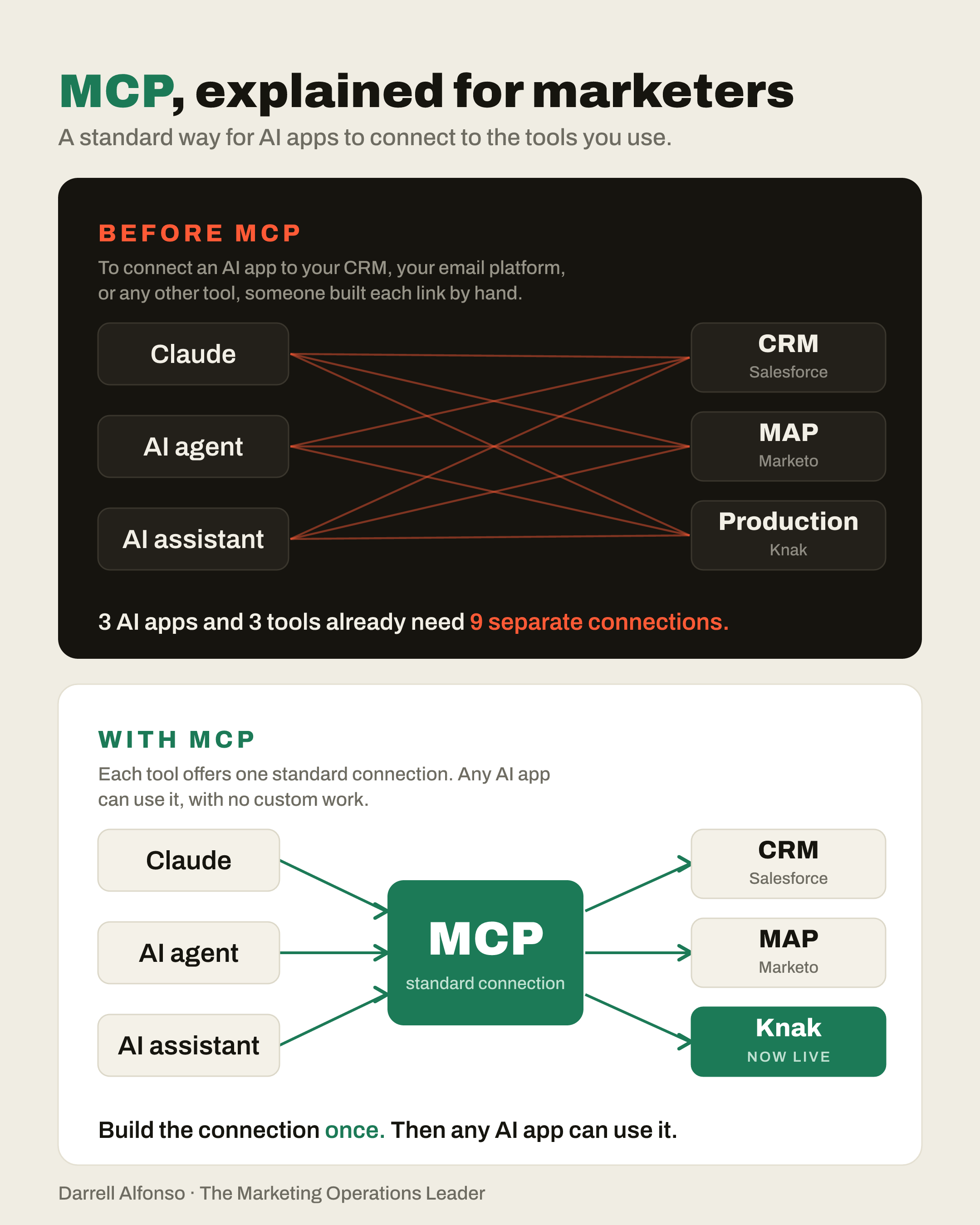
Big win for marketers. An AI assistant can read your CRM, review a campaign, and build an asset, because your tools finally share one connection instead of sitting on islands.
And it is already real. Knak just shipped an MCP server, so an AI agent can call Knak directly and produce on-brand emails and landing pages. Your production layer is now something AI can use, not just a place people log into.
Here is the part that matters for operations leaders. MCP does not change your strategy. It changes the cost of connecting AI to the systems you run. The teams that win will not be the ones with the most tools. They will be the ones who decided, on purpose, which systems AI should reach first and what it is allowed to do once it gets there.
Which tool in your stack would you connect first?
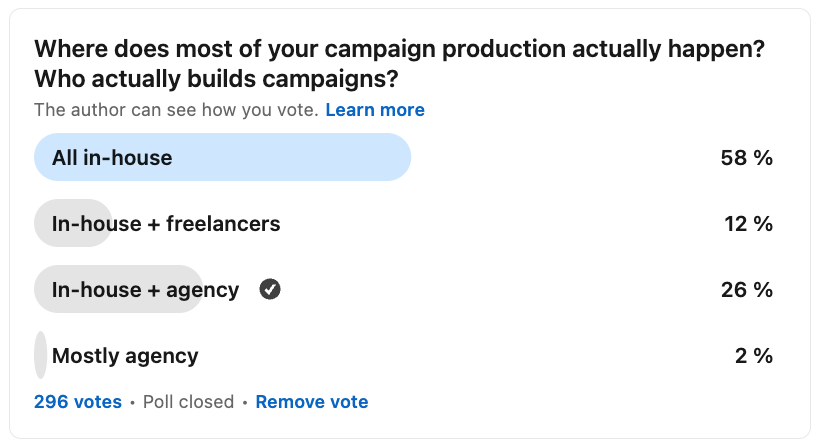
POLL: Who actually builds campaigns?
Top Commentary on Social
In all of the organizations that I have worked, majorly both creative production & campaign production work used to happen by in-house teams. And here I am referring specifically to Website updates and Email marketing campaigns. This was so as to ensure quality control, brand guidelines, and adherence to time-lines (specifically to Email campaigns). However, for SEO/SMM campaigns, we reached out to external specialized agencies since they knew the online market dynamics in much more detail. I hope this helps. - Arjun Mohan
it really depends on who you have on the team internally. do you have DM skills in house, campaign mgmt, branding... you could outsource any spoke to supplement what is already existent. I think in-house + CPD is more valuable though, ultimately. It cultivates consistency and standardization. - Lauren Bailey
AI-Powered Campaign Creation: Ship 5-10X Faster with AI
Knak builds complete, on-brand emails and landing pages, ready to send, without waiting on designers or developers. It integrates directly with Marketo, Eloqua, HubSpot, and SFMC so marketers can launch in minutes instead of weeks.
If campaign creation is your bottleneck, this is worth a look.
5 Lessons I Learned From Jason Dobbs About AI Readiness
From the latest Humans of Martech, Episode 221, where Phil and I sat down with Jason Dobbs, Head of Marketing and GTM Engineering at Kumo AI.
Most teams have heard the warning that AI is only as good as the data you feed it. They nod. They repeat it. Then they miss the part that actually matters, which is what the failure looks like when the model is already running. Jason Dobbs spent seven years assembling intelligence briefings for the President, and he says the AI failures he sees in martech are the same problem he was solving back then: people acting on context they never actually agreed on. Five lessons stuck with me.
1. AI failure does not look like a crash. It looks like a clean, confident, wrong answer. Scores come back precise. Summaries read as coherent. Recommendations feel grounded. The output passes a surface inspection, so nobody pushes back. The problem only shows up when someone asks the follow-up: why did you score this account that way, and who owns the decision that follows? That is when the logic falls apart.
2. AI does not flag your team’s disagreements. It scales them. When sales and marketing never agreed on what a qualified lead actually means, the model does not stop and ask. It picks a version and runs. You get an unresolved internal argument, dressed up as a confident answer, running at machine speed.
3. Stop waiting for perfect data. Define what one workflow actually needs. The warehouse always has gaps. The CRM always has problems. Perfect data does not exist, and waiting for it is how teams stall for years. Jason calls the alternative Minimum Viable Readiness. The question is not “is our data clean,” it is “what is the minimum context and control this specific workflow needs to produce a trustworthy output.”
4. Context has concrete parts, so treat it like a checklist. For any AI decision, the context it runs on breaks down into the definitions it operates from, the data sources it can reach, the tools it can call, the memory it carries between sessions, the guardrails on what it can do alone, and the escalation path back to a human when confidence runs low. You answer those per workflow, not by cleaning the entire warehouse first.
5. Marketing ops is no longer the team that fixes the data. It is the team that defines the context. The shared definitions, the trusted sources, the named owners, the guardrails. That is the product now. The ceiling on any AI system is the clarity of what the business agreed it was optimizing for before anyone touched a model.
What to do Monday morning: pick one AI workflow you want to ship. Write down the five terms it depends on most, things like pipeline, qualified lead, active customer, opportunity, and churn. Get sales, marketing, and ops to sign off on one definition each before the model sees any of them. If nobody can cleanly say who owns the decision the output triggers, you are not ready to automate it yet.
