
Marketing Operations Will Never Be Replaced by AI
Also: What Claude Actually Helps With in Marketing Ops, and Where It Doesn't

In this edition:
Marketing Operations Will Never Be Replaced by AI
POLL: Most Marketing Automation Platforms Have Messy Data Because…?
5 Things You Need to Know About Content Engineering
For Paid Subscribers: What Claude Actually Helps With in Marketing Ops, and Where It Doesn’t
Register For Free Marketing Ops Town Hall Where We’ll Talk About How To Get A New Marketing Ops Job In 2026!
Speed alone doesn’t win lead routing anymore.
Only 13% of orgs respond within 5 minutes (2026 MOPS survey). The bottleneck isn’t your flow. It’s the dirty data hitting it.
Learn the 6 key data requirements, 10+ enterprise routing flows, and how AI fits in.
Marketing Operations Will Never Be Replaced by AI
Every week someone predicts it. AI is coming for marketing ops. The flows build themselves, the reports write themselves, and the function disappears.
I’ve done this work for over a decade, across AWS, Indeed, and now Impellam, and I use AI every day. The prediction is wrong, not because AI is weak, but because the people making it don’t understand what marketing ops actually does.
Four reasons the function survives.
1. The job is problem-solving, not task execution.
People think ops is a task list: build the flow, clean the list, pull the report. If that were the job, you could automate it. But the tasks are the easy part. The real work is figuring out which task to do, in what order, with what tradeoffs nobody wrote down. When a lead doesn’t route, the question is whether that’s a data problem, a flow problem, an ownership problem, or a definition problem, and AI can’t tell you which. It executes the fix once you’ve diagnosed it. The diagnosis is the job.
2. Someone still has to understand the systems underneath.
AI doesn’t remove the need for technical fluency, it raises the bar. To get anything useful out of a tool, you have to know what a good output looks like, how your objects relate, and why a sync breaks. The marketer who can’t read the stack can’t check the AI’s work, which means they can’t trust it or ship it. AI is a force multiplier on expertise, and it does nothing for the person who had no expertise to multiply.
3. AI is still mostly internal-facing.
Look at where AI actually works in marketing right now: drafting, summarizing, first-pass analysis. These uses make the operator faster, but they don’t run the operation. No AI today owns your lead lifecycle end to end and answers to leadership when a number is wrong. The accountable human is still accountable.
4. Nobody at the top knows how this plays out.
Sit in the rooms where the decisions get made and the most senior leaders all say the same thing: nobody knows where this lands. When the future is that unclear, you don’t bet your operating function on a tool that’s eighteen months old. You keep the people who can adapt as the tool changes, because adaptability lives in humans, not in this quarter’s model.
The automation argument already lost once.
Marketing automation was supposed to replace everyone too, and it didn’t. It made bad processes faster and exposed every team that didn’t know what it was doing. AI is the same story at a higher level. You cannot automate your way to success if you don’t know what success requires, and knowing what needs to happen in your business, with your constraints, is exactly what marketing ops exists to figure out.
That part isn’t going anywhere.
POLL: Most Marketing Automation Platforms Have Messy Data Because…?
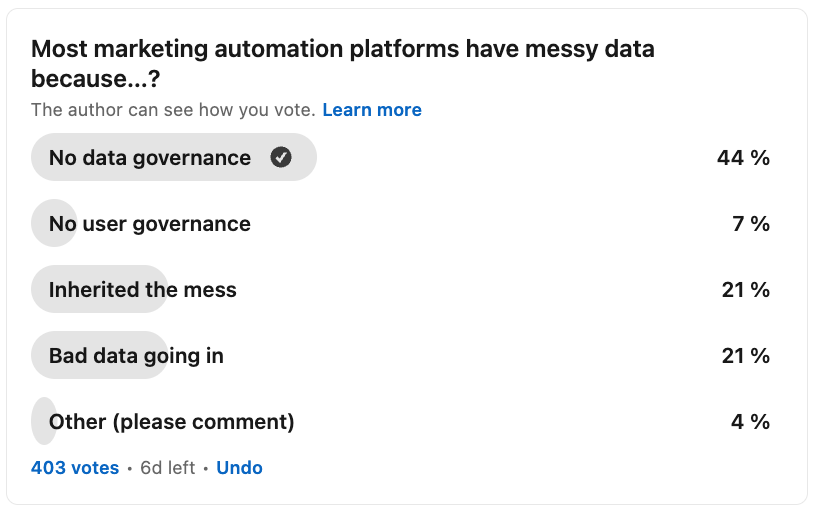
Top Commentary on Social
The issue is cumulative and interconnected, not isolated to a single checkbox.
Most messy MAP data is usually the result of multiple governance failures compounding over time. - Tammy Ware
All of the above - AJ Sedlak
Had to go with “inherited the mess” 😅 Especially in B2C/D2C brands with 10+ years of history - multiple tools, migrations & quick fixes layered over time. By the time you step in, you are not building systems… you are untangling them. - Trisha Chhabra
AI-Powered Campaign Creation: Ship 5-10X Faster with AI
Knak builds complete, on-brand emails and landing pages, ready to send, without waiting on designers or developers. It integrates directly with Marketo, Eloqua, HubSpot, and SFMC so marketers can launch in minutes instead of weeks.
If campaign creation is your bottleneck, this is worth a look.
5 Things You Need to Know About Content Engineering
Content engineering means treating all the content your company has published as a living system you maintain and keep accurate over time, rather than a pile of articles you write once and forget. Phil dug into it with Alex Halliday, founder and CEO of AirOps, on episode 220 of Humans of Martech. Here are five things worth understanding as AI reshapes how people find information online.
1. AI is changing how customers find you, and old content is invisible to it.
When someone asks ChatGPT a question about your industry, the AI doesn’t show ten links. It reads across the web and returns one answer, favoring content that is recent and accurate. An article from 2022 with outdated facts doesn’t just rank lower, it gets left out entirely. Webflow refreshed its existing articles and saw 42% more traffic, with the AI-driven visits converting six times better than normal. Updating what you already have can matter more than writing something new.
2. Your best content comes from what only your company knows.
AI can produce generic content that recombines what’s already on the internet, and it tends to perform poorly. Content built on what only your business knows, like real customer conversations and proprietary data, performs far better. Most companies sit on this material in sales call recordings and support tickets without ever turning it into something customers can find. The advantage goes to whoever gets that knowledge out into the world.
3. The goal is more human involvement, not less.
It’s tempting to assume the point is to take people out of the process, but Alex argues the opposite. The system’s job is to bring the right expert into the conversation at the right moment to add the perspective only they have, while the AI handles the busywork around them. The human insight is what makes the content worth citing.
4. Once you speed up content creation, the new problem is review.
When a team can suddenly produce far more content, the limiting factor stops being how fast you can write and becomes how carefully someone can check the work. Companies that scale production without scaling review end up with a large, inconsistent library that describes the business in conflicting ways. Quality control becomes the hard part, and most teams underinvest in it.
5. Most of the work happens before anything gets written.
The instinct is to focus on the AI tool and the wording of the request, but Alex says the bulk of the real effort is deciding where the right information lives and gathering it first. Connect the places your company already stores knowledge, get that foundation right, and the writing step largely takes care of itself.
Listen to the full episode on Humans of Martech.
