
How to Create a Martech Strategy Rollout Plan with Claude
Also: Your AI Agent Cannot Tell Correlation From Cause

In this edition:
How to Create a Martech Strategy Rollout Plan with Claude
Your AI Agent Cannot Tell Correlation From Cause (Humans of Martech, Ep. 227)
For Paid Subscribers: When the Exec Runs Your Plan Through AI and Likes His Timeline Better Than Yours
AI-Powered Campaign Creation: Ship 5-10X Faster with AI
Knak builds complete, on-brand emails and landing pages, ready to send, without waiting on designers or developers. It integrates directly with Marketo, Eloqua, HubSpot, and SFMC so marketers can launch in minutes instead of weeks.
If campaign creation is your bottleneck, this is worth a look.
How to Create a Martech Strategy Rollout Plan with Claude
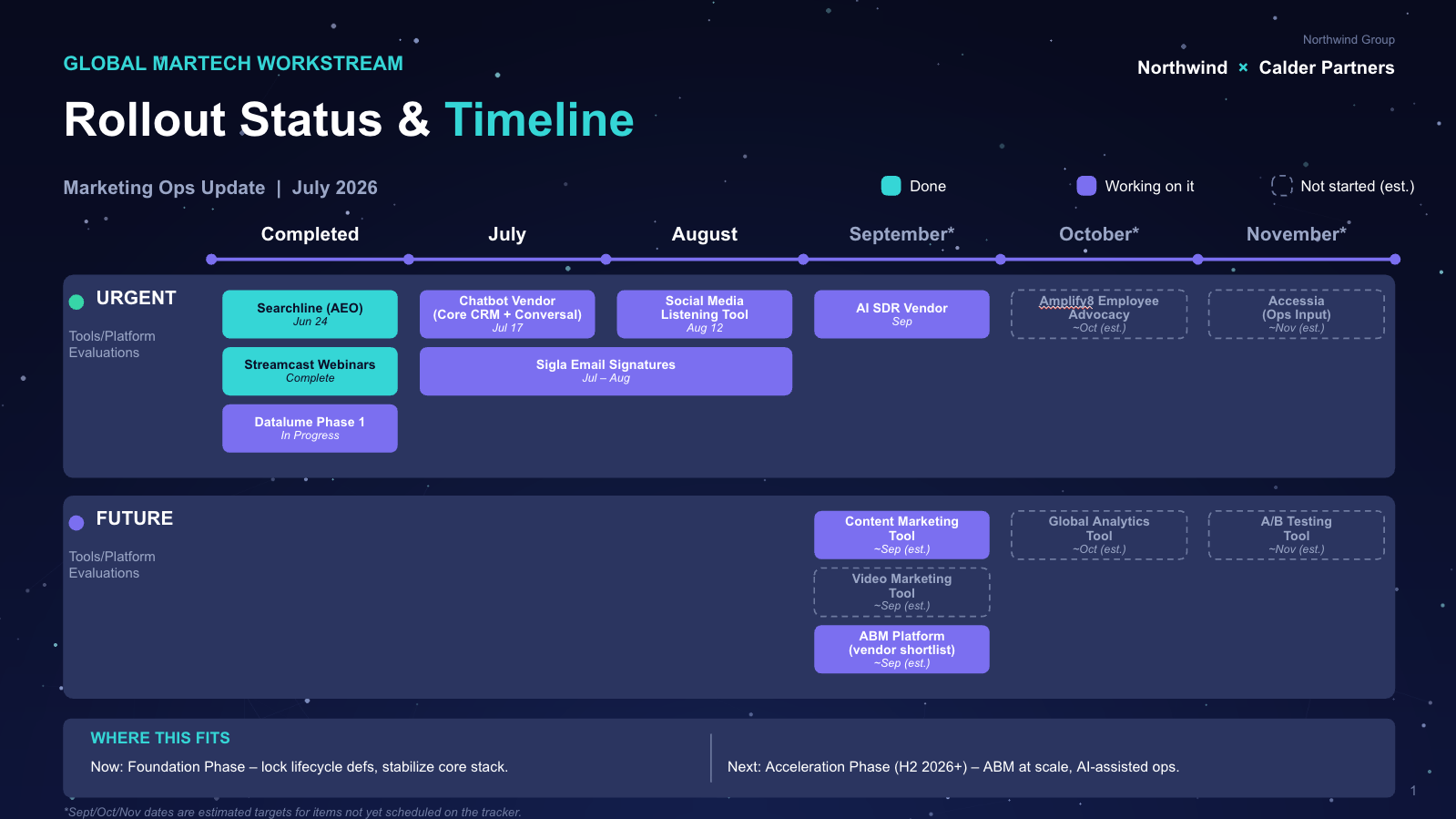
Most martech rollout plans are a list of tools with dates next to them. Someone picks a go-live for each one, spaces them across the calendar until the quarters look balanced, and the plan holds up right until two tools need the same admin in the same week. The plan was never wrong about the dates. It was wrong about the order.
A rollout plan is a sequencing model. The calendar is what the model produces after you know which work blocks which other work, and which tool has to land before the next one is worth buying. Build the calendar first and you will discover in September that the ABM platform you scheduled cannot run on the data model your enrichment project has not finished, and the enrichment project is waiting on a security review nobody assigned.
Asking Claude for “a 2026 martech roadmap” returns a generic template built from every roadmap on the internet, none of which knows about your code freeze or the fact that one person owns four of your integrations. The job is to give it your real constraints and make it reason about the order.
Here is how I built ours.
1. Load the facts before you ask for anything
Open a Project in Claude and put your real material in the knowledge base, so you set the context once instead of re-pasting it into every chat.
Ours holds the stack inventory, the vendor evaluations in flight, and a plain document naming who owns what and their realistic weekly capacity. Add the things that never make it into a plan: quarter close dates, code freeze windows, when your admin is on leave, how long IT actually takes to provision SSO.
The quality of the plan is set here. A model reasoning over your evaluation list and your freeze calendar produces something different than a model reasoning over a blog post about martech strategy.
2. Ask for the dependency map, not the dates
Your first prompt should never mention a date. Ask for the work items and what each one waits on.
“From the documents in this project, list every discrete work item required to take each tool from evaluation to production. For each item, name what must be finished before it can start, who owns it, and roughly how long it takes. Do not assign dates. Output a table.”
You will get somewhere between 30 and 60 items, and you will immediately see three that are missing and two that do not apply to your instance. Correct them in the chat. The correction is the point.
3. Separate the work that has a date from the work that has an estimate
This is the discipline the artifact enforces. Our board carries two rows. The urgent row holds committed work: the AEO platform, closed in late June. The chatbot vendor, mid-July. Social listening in mid-August, an AI SDR vendor in September. The future row holds items nobody has scheduled: a content marketing tool, a global analytics tool, an ABM platform, A/B testing.
Every date past August on that board carries an asterisk, and the footnote says those are estimated targets for items not yet on the tracker. That asterisk is the most honest thing on the slide. Ask Claude to mark every date as committed or estimated and to state what has to happen before an estimate becomes a commitment. An executive reading a plan where all dates look identical will hold you to all of them.
4. Attack the plan before your stakeholders do
Ask the model to break the thing it just built.
“You are the CIO reviewing this plan. Name the five assumptions most likely to be wrong, and for each one, tell me what slips and by how long.”
You get back the SSO provisioning estimate, the assumption that the data team has bandwidth in the same sprint, the vendor’s stated migration speed. Then ask what happens if any one of them slips two weeks. You walk into the leadership review already knowing which three items you have to protect.
5. Keep the artifact where the plan lives
The rollout plan is a document you revise weekly, not a deliverable you produce once. Because the Project retains your uploads, you return to it after each vendor call, paste in what changed, and ask for the revised sequence rather than rebuilding the plan from memory. The version that goes stale is the version in a slide from the kickoff meeting.
The judgement stays yours. Claude does not know that your VP will not approve a November go-live, or that the vendor’s implementation consultant is on their third rollout this quarter. What it does is hold 50 dependencies in view at once and tell you what breaks when one of them moves, which is the part humans do badly under deadline pressure.
Open your last rollout plan and trace one item on it back to the thing it was actually waiting on. If you cannot name that thing, the plan was a calendar.
Your AI Agent Cannot Tell Correlation From Cause
Episode 227 of Humans of Martech asks what happens after you get the data infrastructure right. Your warehouse is clean, your agents are running, the dashboard is green, and the system is scaling a mistake. Here is what matters for operations leaders.
1. A warehouse records what happened, not what your action caused
Jason Dobbs, head of marketing ops and GTM engineering at Kumo, frames the distinction plainly: a warehouse is a record, not a rulebook for what an agent should do next. A product that correlates with high lifetime value does not necessarily cause it.
Tobias Konitzer of GrowthLoop tells the version of this story that should worry you. A CRM leader at a large outdoor brand found that high-LTV customers strongly correlated with viewing one specific pair of jeans, so the obvious move was to push the jeans into the welcome flow. The correlation ran the other way. Those customers already had high LTV before they ever saw the jeans. The analysis was reproducible, data-supported, and useless, because nobody asked which direction the arrow pointed.
2. Agents scale the wrong lever at machine speed, and the dashboard stays green
Give an agent the goal of converting free users to paid and it finds the discount campaign that preceded a spike in conversions. It concludes the campaign works and scales it. What it cannot see is that those users were already on the edge of paying. Run that logic across every matching cohort and you hand discounts to people who would have paid full price, you teach your most engaged users to wait for an offer, and revenue per conversion drops while the conversion dashboard looks excellent.
The damage surfaces in the numbers weeks after the agent has applied the same logic to millions of people. Simon Lejeune at Wealthsimple built the counter-question into policy: when someone shares a campaign result without an incrementality breakdown, he asks what the impact actually was. That is the question agents never ask.
3. Attribution tells you where to look, not what caused the outcome
Rajeev Nair of Lifesight makes the problem concrete with a billboard directly outside a store. Every customer who walks in has seen it, so exposure always precedes purchase and the correlation is perfect. The billboard may have brought in nobody. Journey data records what happened next to what, and it cannot record what would have happened without the intervention, which is why bottom-of-funnel touches always look decisive.
Nadia Davis of CaliberMind draws the line ops teams need to hold. Reporting tells you the number in the tool. Analysis tells you what is working. An agent that reads attribution correlations as causal proof will confidently rebuild the strategy that made last quarter look good, for reasons that were never true.
4. Holdouts buy you time while the causal record gets built
The long-term fix is a stored history of experiments: the customer state, the intervention, the measured uplift, and what was happening in the market at the time. Build that across years and you can ask what a different message would have done for a customer in that exact state. There is no shortcut, and teams that started two years ago have causal history you cannot buy.
Three practices reduce your exposure in the meantime. Put a holdout group on every agent-driven campaign so you can see the baseline without the intervention. Set a rule that no agent scales a behavior past 10 percent of the audience until a human reviews the causal logic it assumed. Write down what the agent is optimizing for before it runs, because if you cannot state the causal chain, the agent is not ready to run on its own.
