
How to Build a Data Layer AI Can Trust
Also: the CRM is losing its grip as the source of truth, and how to survive an impossible workload in marketing ops.

In this edition:
How to Build a Data Layer AI Can Trust
Your CRM Stopped Being the Source of Truth (Humans of Martech, Ep. 225)
For Paid Subscribers: How to Handle an Impossible Workload in Marketing Ops
Data Agents Can Solve All Your GTM Data Problems
Your revenue engine runs on the data in your CRM. Yet most of it still depends on data providers, spreadsheets, and manual cleanup that were never built to get it right. Data Agents enrich, deduplicate, and correct every account, then keep it that way. Check out the new Data Agents from Traction Complete.
How to Build a Data Layer AI Can Trust
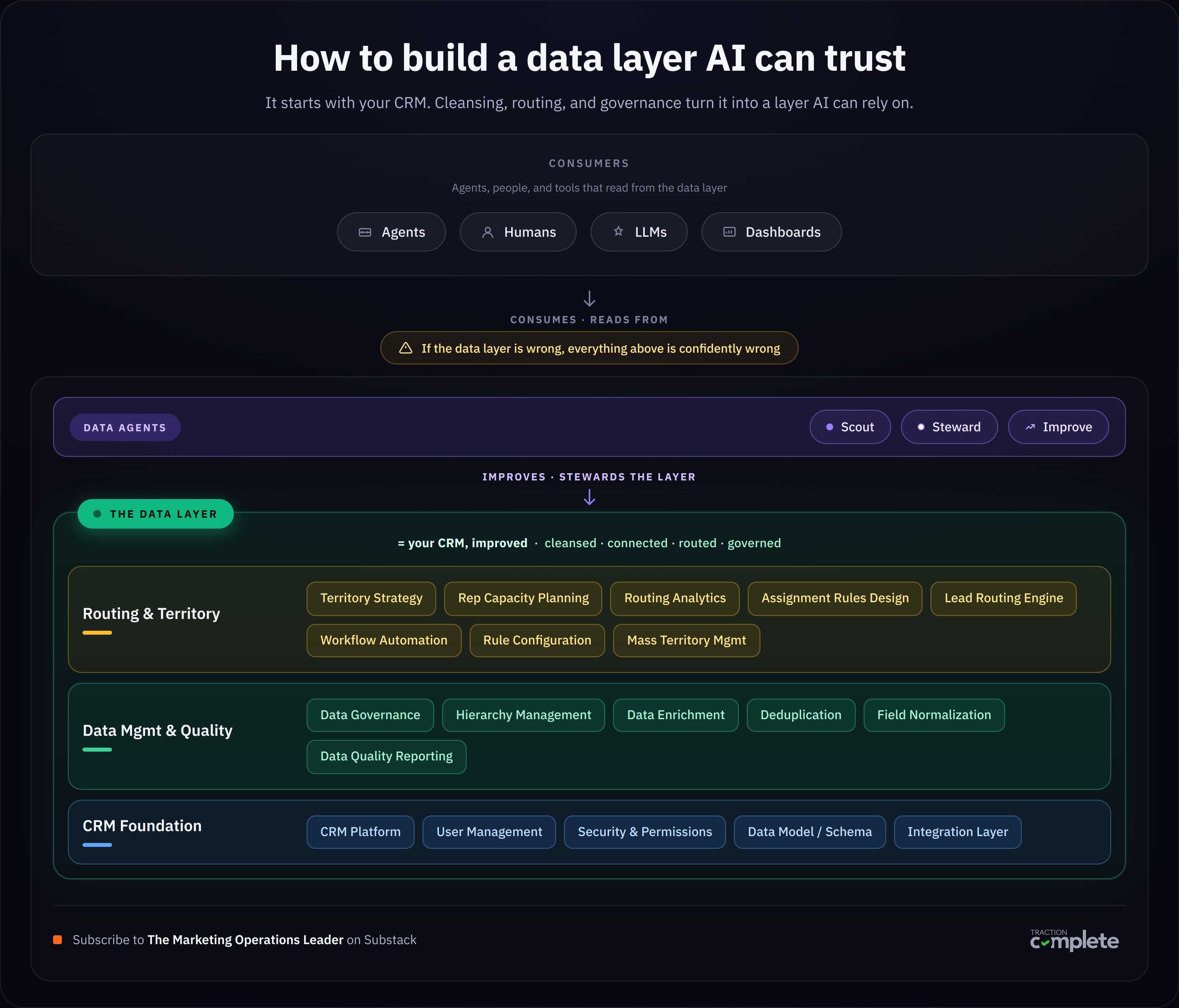
Everyone is racing to put AI on top of their GTM, and almost nobody is checking what it is standing on. The part teams skip is the foundation: AI is only as trustworthy as the data layer beneath it.
AI does not check your data before it acts; it acts on whatever is there. So when the layer is wrong, AI does not catch the mistake. It scales the mistake across every campaign, every routing decision, and every report that reads from it.
The good news is that the data layer is not a new tool you buy. It starts with the CRM you already have. Cleansing, connecting, routing, and governance are what turn that CRM into a layer AI can rely on.
There are four places where that trust is won or lost.
1. CRM foundation. Start by asking whether your pipeline and demand-gen data can actually be trusted. This is the base everything else sits on, and if the records underneath are wrong, nothing above them recovers.
2. Data quality. Duplicates and outdated records are the most expensive problem in the stack. A duplicated account sends the same lead to two reps, and a stale field routes a real buyer to the wrong place. AI does not clean any of this; it inherits it.
3. Routing. Routing has to be automated. The moment assignment depends on someone remembering to move a record, leads sit, SLAs slip, and the agent acting on top of that routing inherits the delay.
4. Stewardship. Someone has to own the rules and the governance. Without a named owner, definitions drift, exceptions pile up, and the layer stops meaning what everyone assumes it means.
Get those four right, and everything above the layer improves at once. The agents, the dashboards, and the people all read from a foundation they can trust.
The team at Traction Complete works on this data layer for a living, which is why I keep coming back to it. The teams moving fastest on AI are not the ones with the best models. They are the ones who fixed the layer underneath first.
AI-Powered Campaign Creation: Ship 5-10X Faster with AI
Knak builds complete, on-brand emails and landing pages, ready to send, without waiting on designers or developers. It integrates directly with Marketo, Eloqua, HubSpot, and SFMC so marketers can launch in minutes instead of weeks.
If campaign creation is your bottleneck, this is worth a look.
Your CRM Stopped Being the Source of Truth

Humans of Martech, Episode 225
Phil went solo for this one, and it is worth calling out. Episode 225 kicks off a four-part series called The Dungeon of Martech Architecture, built as a level-by-level “dungeon crawl” inspired by the Dungeon Crawler Carl books. It is creative, genuinely fun, and a real swing for a martech podcast. Congrats to Phil on launching such an ambitious and original body of work.
Part 1, The Fall of CRM Gravity, makes an argument worth sitting with.
The CRM lost its authority by accumulation, not by any single failure. It was built to track the sales motion, then every team moved in: marketing, leadership, product, customer success, until it became the unofficial source of truth nobody actually decided it should be. The edits overwrite each other, and the data ends up looking authoritative while the real authority belongs to whoever ran the last import.
The fix is to let the warehouse take the brain. Phil lays out the warehouse-first path: extract raw data into a cloud warehouse, transform it there with something like dbt, then activate it back to your tools through reverse ETL. Definitions stay centralized, changes stay version-controlled, and audiences become portable instead of being rebuilt in every tool.
The deeper trap is the reflex to copy data back out. You do the hard work to centralize, then immediately export copies to every downstream tool, where each copy starts drifting. Phil calls this the Export Hydra, and the answer is zero-copy data sharing where tools read a live view of the warehouse instead of receiving an export that drifts the moment it leaves.
Here is why it matters now. Every AI agent reads from somewhere, and if it reads from a patchwork of drifting copies, it inherits all of it. A governed warehouse is becoming the prerequisite for agents you can actually trust.
