
How to Build a Customer Lifecycle Tech Stack Diagram
Also - How to Run a Gap and Redundancy Analysis on Your Tech Stack

In this edition:
How to Build a Customer Lifecycle Tech Stack Diagram
Exclusive For Paid Subscribers: How to Run a Gap and Redundancy Analysis on Your Tech Stack
AI-Powered Campaign Creation: Ship 5–10X faster with AI. Knak builds complete, on-brand emails and pages ready to send. Check out Knak AI here.
How to Build a Customer Lifecycle Tech Stack Diagram
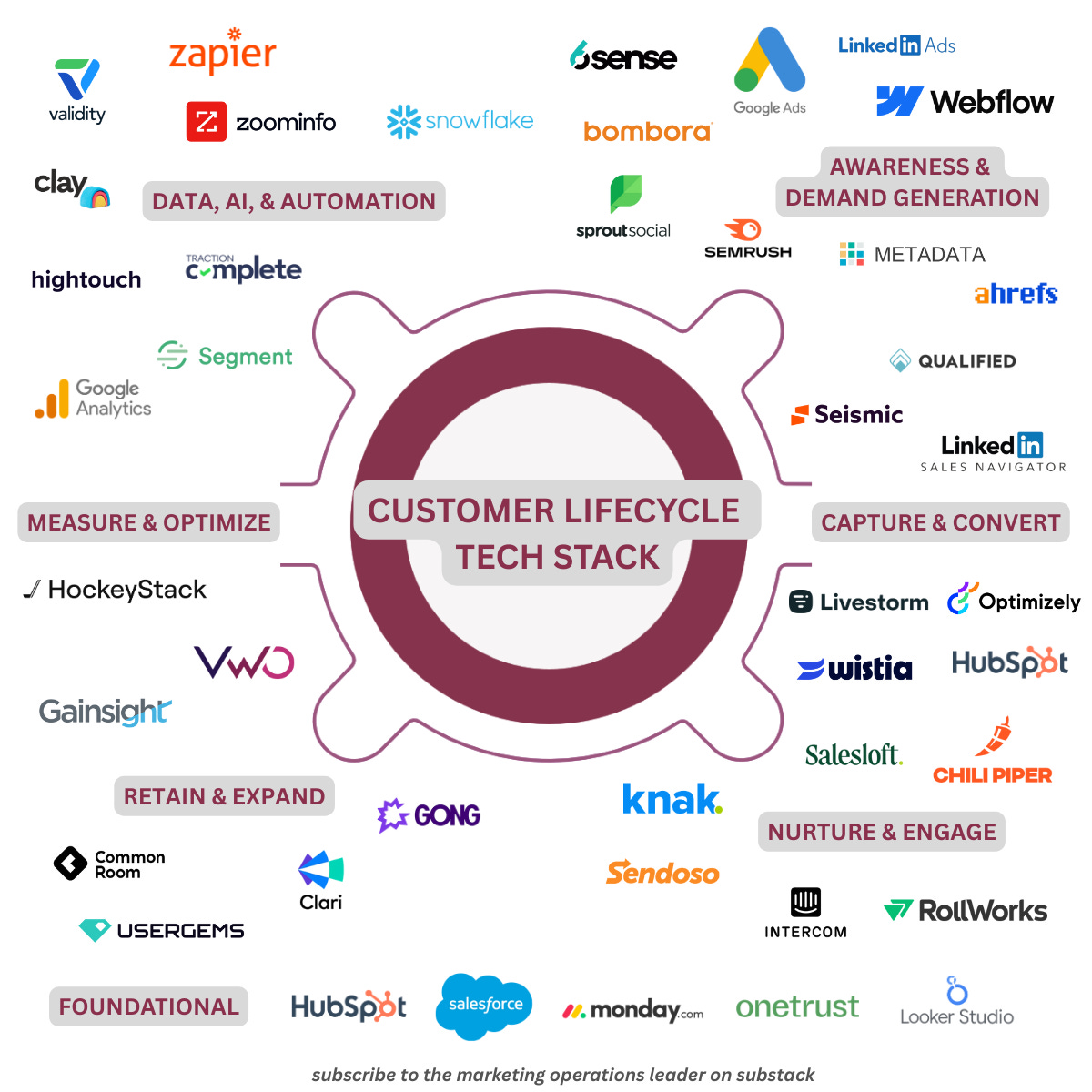
One of the best strategies for creating a tech stack diagram is basing it on the customer lifecycle. Here’s how to do it.
The Framework
Take all your tools and fit them into lifecycle categories. You can adjust these, but here’s a solid starting point:
Data, AI, & Automation
Awareness & Demand Generation
Capture & Convert
Nurture & Engage
Retain & Expand
Measure & Optimize
Foundational (the infrastructure everything else depends on)
Why This Approach Works
Listing your tools by lifecycle stage immediately reveals gaps. If you’re light on Retain & Expand or weak on Measure & Optimize, you’ll see it instantly. And you really do need all these capabilities to support a solid customer lifecycle strategy.
Once you map your current state, you can identify what’s missing and what tools could fill those gaps.
The Tools I Included
These are great examples for a mid-sized company. If you’re a startup, choose cheaper alternatives. If you’re enterprise, prioritize security, longevity, and complex workflow management. Context matters.
Key tools by category:
Data layer: Segment, Snowflake, Hightouch, Clay, ZoomInfo, 6sense
Demand gen: Metadata, SEMrush, Bombora, LinkedIn Ads, Google Ads
Capture: Qualified, Seismic, LinkedIn Sales Navigator, Chili Piper
Nurture: Intercom, Salesloft, RollWorks
Retain & Expand: UserGems, Common Room, Sendoso, Gong, Clari
Foundation: HubSpot, Salesforce, Snowflake, OneTrust, monday.com
How I Built This
I used Canva because I care about design, but you could use PowerPoint or Google Slides.
The real trick? Heavily lean on AI to pressure test your choices. I used Claude to challenge my initial tool list and categorization. Claude pushed back on about 30% of my picks, which improved the final diagram significantly.
I’ve also been liking ChatGPT agent mode for deep research on specific tools and categories. These AI tools can quickly validate whether your stack makes sense or identify alternatives you haven’t considered.
Your Action Plan
Map your current tools to lifecycle categories
Identify where you’re light (gaps = investment opportunities)
Use AI to pressure test your stack and find alternatives
Create the visual (Canva, slides, or have AI generate it)
Show your boss or team where you’re weak and where you should invest
The diagram itself takes an hour or two. The thinking behind it is what matters. What capabilities does your business actually need? Where are you underinvesting? What’s foundational vs. nice-to-have?
Answer those questions, and the diagram writes itself.
Knak: Campaigns Without the Backlog
Tired of slow builds and brand inconsistencies? Knak gives marketers a no-code way to create on-brand emails and landing pages - without waiting on technical resources.
It plugs right in to Marketo, Eloqua, SFMC, Hubspot, and more, so teams can launch in minutes, not weeks.
See how Knak makes campaign ops effortless.
Quick plug: I co-host the Humans of Martech podcast.
We talk to operators, leaders, and builders about how martech really gets implemented, broken, fixed, and scaled.
If you like practical ops conversations, you’ll like it.
