
Creating a Martech product requirements doc with TEMPLATE
Also - How to Build Key Relationships Fast in Marketing Ops

In this edition:
Creating a Martech product requirements doc with TEMPLATE
Exclusive For Paid Subscribers: How to Build Key Relationships Fast in Marketing Ops
AI-Powered Campaign Creation: Ship 5–10X faster with AI. Knak builds complete, on-brand emails and pages ready to send. Check out Knak AI here.
Creating a Martech Product Requirements Doc with TEMPLATE
Martech projects fail when stakeholders aren’t aligned. Regional teams build different assumptions. IT flags technical constraints too late. Legal discovers compliance issues during implementation.
A Product Requirements Document (PRD) solves this by creating a single source of truth before you start building or buying.
What a PRD Actually Is
A PRD defines what you’re building and why. It’s the contract between your vision and what gets delivered.
Unlike a Market Requirements Document that explains why a problem matters, a PRD focuses on what you’ll build to solve it. For martech teams, it translates marketing objectives into concrete features that cross-functional teams can execute against.
Why PRDs Matter for Martech
Martech projects involve diverse stakeholders across regions, functions, and time zones. Without a shared blueprint:
Requirements conflict across regions
IT discovers integration issues late
Legal flags compliance problems during implementation
Scope creep derails timelines
Teams duplicate work or miss dependencies
A good PRD provides:
Alignment. Everyone understands goals and how they contribute.
Clear communication. Single source of truth reduces misunderstandings.
Scope management. Reference point for evaluating new requests.
Risk mitigation. Identify data privacy, compliance, and vendor concerns early.
Efficient development. Clarify requirements up front, avoid rework.
For global teams, a PRD works as an asynchronous guide. Regional teams can add requirements, flag risks, and track decisions regardless of time zone.
How to Create a Martech PRD
1. Gather input early
Solicit requirements from all stakeholders: marketing, product, engineering, design, sales, legal, IT. Define clear roles and interdependencies up front.
2. Define shared goals
Align on user and business objectives. For martech, that might include increasing employee advocacy, improving brand health, or consolidating tools. Everyone needs to know what success looks like.
3. Document role-specific details
Tailor sections for each function:
Engineering: API support, integration requirements, data flows
Design: UI/UX considerations, user workflows
Marketing: Key messaging, content requirements
Legal: Compliance, data governance, regional regulations
IT: Security, infrastructure, existing tech stack
Clarify dependencies between teams so backend work doesn’t block frontend launch.
4. Structure the document
Use this framework as your template:
Purpose & Goals Why this project exists and key objectives (transparency, scale, governance).
Scope What’s in scope and explicitly what’s not. Be specific.
Core Capabilities Must-have features vs. nice-to-haves. Prioritize ruthlessly.
Team & Regional Requirements Regional needs, budget, regulations, localization, integration constraints.
Users & Personas Who uses this and how. Include role-specific workflows.
Success Criteria How you’ll measure adoption, efficiency, and performance. Define metrics.
Vendor Landscape & Scorecard Candidate solutions and weighted evaluation criteria.
Evaluation Timeline Phases: requirements gathering, demos, trials, recommendation.
Roles & Responsibilities Who owns what. Who evaluates, provides feedback, handles integration, security, legal.
Risks & Considerations Technical, adoption, and business risks. Include mitigation strategies.
Decision Framework How decisions get made: scorecards, user feedback, commercials. Who has final say.
5. Review and iterate
Share the draft. Collect feedback. Update. A PRD is living documentation—update it when requirements change.
6. Facilitate collaboration
Use shared documents and collaborative tools. For distributed teams, asynchronous communication is essential. Centralize updates so teams across time zones stay aligned.
7. Secure sign-off and governance
Once stakeholders agree, get approval from decision makers. Clarify who owns each section and how changes will be managed.
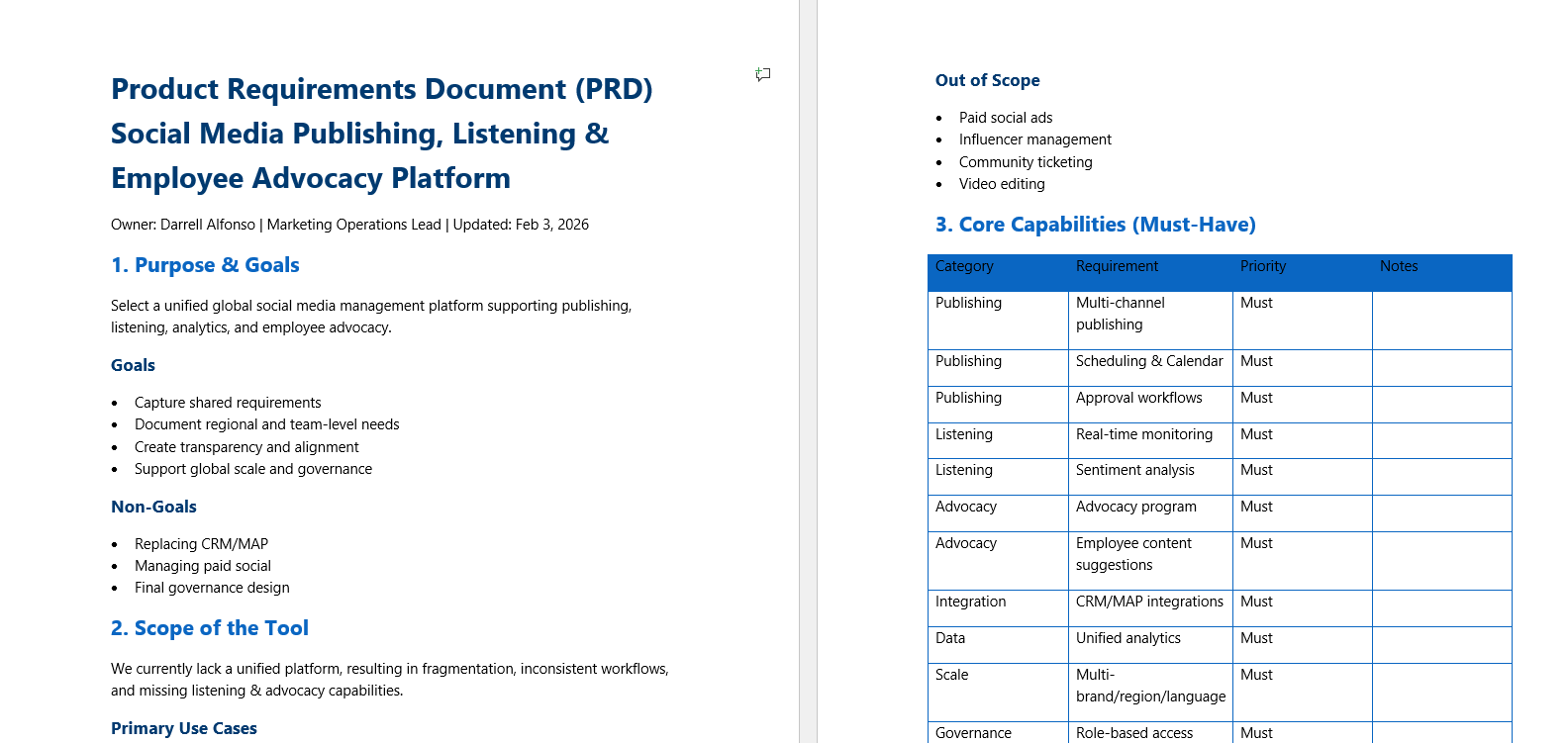
Example: Social Media Management PRD
My social media PRD followed this structure. The project required alignment across regional marketing leaders, social media managers, and IT partners spanning multiple time zones.
The PRD served as the playbook for vendor evaluation. Regional marketers added localized requirements. Legal and IT flagged compliance risks. Executives saw how we’d evaluate vendors and make the final decision. All in one document.
Key sections included:
Purpose: unified platform for publishing, listening, advocacy, and analytics
Scope: explicitly excluded paid ads and influencer management
Core capabilities: multi-channel publishing, approval workflows, real-time listening, sentiment analysis, CRM integrations
Regional requirements: budget constraints, regulations, localization needs
Success criteria: active users, posts per week, engagement rate
Vendor scorecard: weighted evaluation matrix
Risks: data migration, change management, vendor lock-in with mitigation strategies
The structure kept stakeholders aligned through a complex evaluation process.
Get the Template
Creating a PRD isn’t busywork. It’s an investment in clarity and quality. Martech projects succeed when global teams share the same vision and have a reliable reference to guide their work.
Download the full Social Media Management PRD template to see how these components work in practice: [Link to template]
Use it as a starting point for your next martech project. Adapt the sections to your needs, but keep the core structure: clear purpose, defined scope, specific capabilities, success metrics, and decision framework.
The time you invest in a good PRD pays back in faster implementation, fewer surprises, and better outcomes.
Knak: Campaigns Without the Backlog
Tired of slow builds and brand inconsistencies? Knak gives marketers a no-code way to create on-brand emails and landing pages - without waiting on technical resources.
It plugs right in to Marketo, Eloqua, SFMC, Hubspot, and more, so teams can launch in minutes, not weeks.
See how Knak makes campaign ops effortless.
Quick plug: I co-host the Humans of Martech podcast.
We talk to operators, leaders, and builders about how martech really gets implemented, broken, fixed, and scaled.
If you like practical ops conversations, you’ll like it.
